
Lifecycle Cost Optimisation
The cheapest cable to buy is rarely the cheapest cable to own
Minimising upfront cable cost feels like the right call, until you account for the decades of operational losses that follow. Rezo optimises your grid design against the full project lifetime, so the cheapest design is also the most cost-effective one to operate.
The Hidden Cost
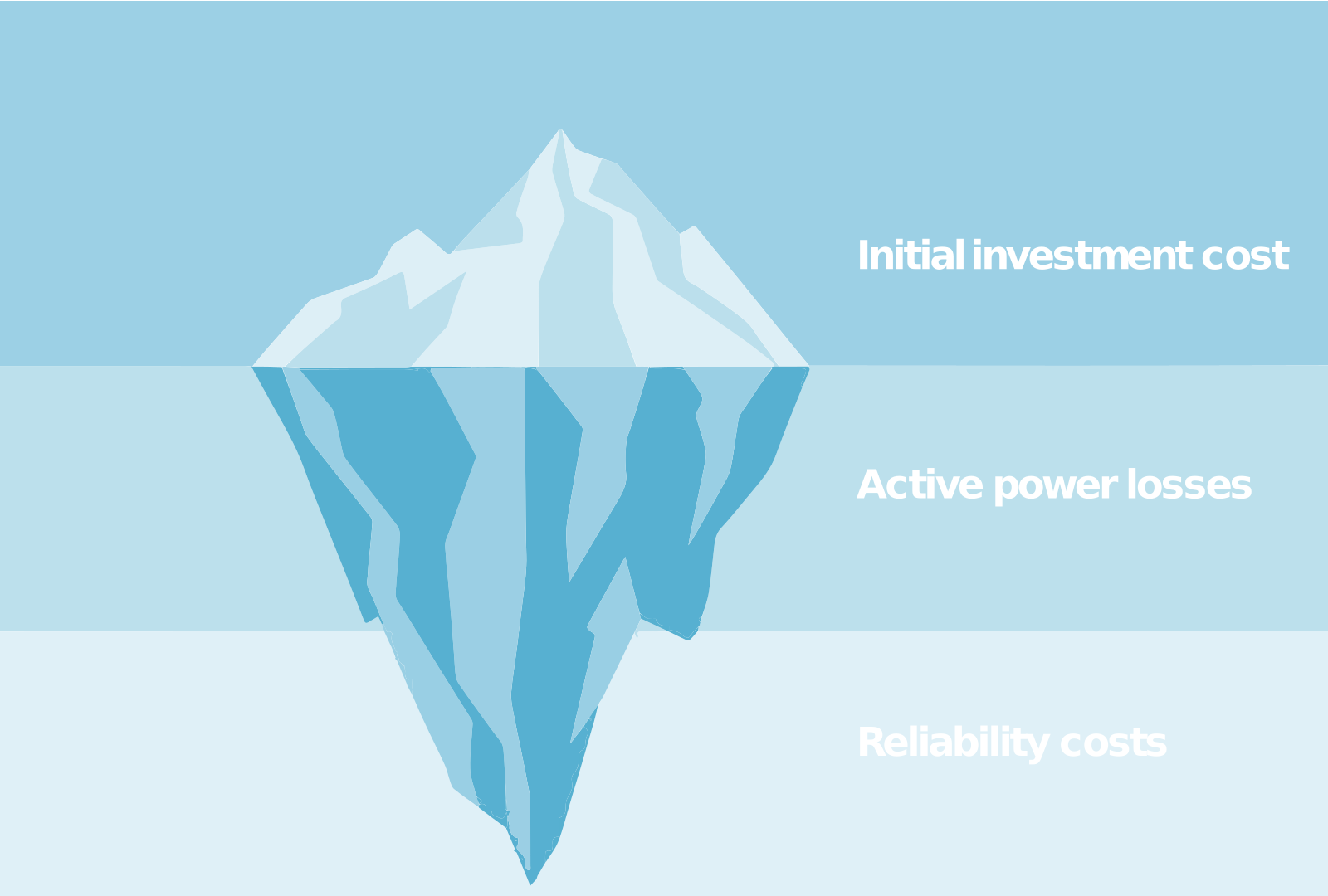
A lot of the cost happens after you build it.
On a typical offshore wind project, operational losses over the project lifetime are comparable to the upfront cable investment. Yet most designs are optimised for the number that is easiest to measure, not the one that matters most.
The Misconception
The cost you can't see is the cost that matters most
Cable sizing decisions made during design lock in operational costs for the lifetime of the project. By the time the gap becomes visible, it's too late to close it.
What manual design misses
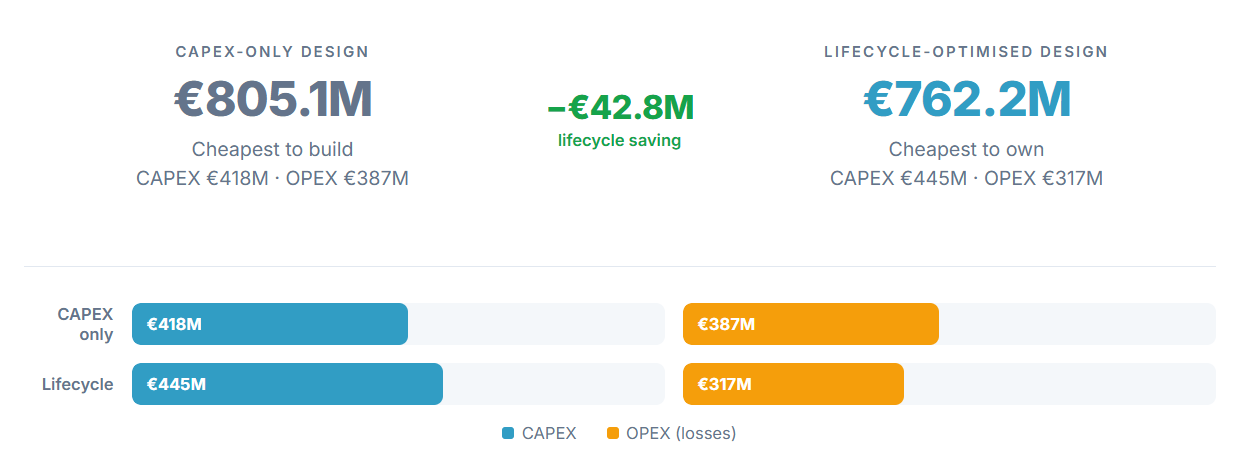
Cable designs sized to meet minimum requirements look efficient on day one. But smaller cables carry higher operational losses year after year. Over a project lifetime, those losses add up and the gap between a CAPEX-only design and a lifecycle-optimised one is routinely measured in tens of millions of euros. By the time the project is operational, it is too late to close it.
How Rezo closes the gap
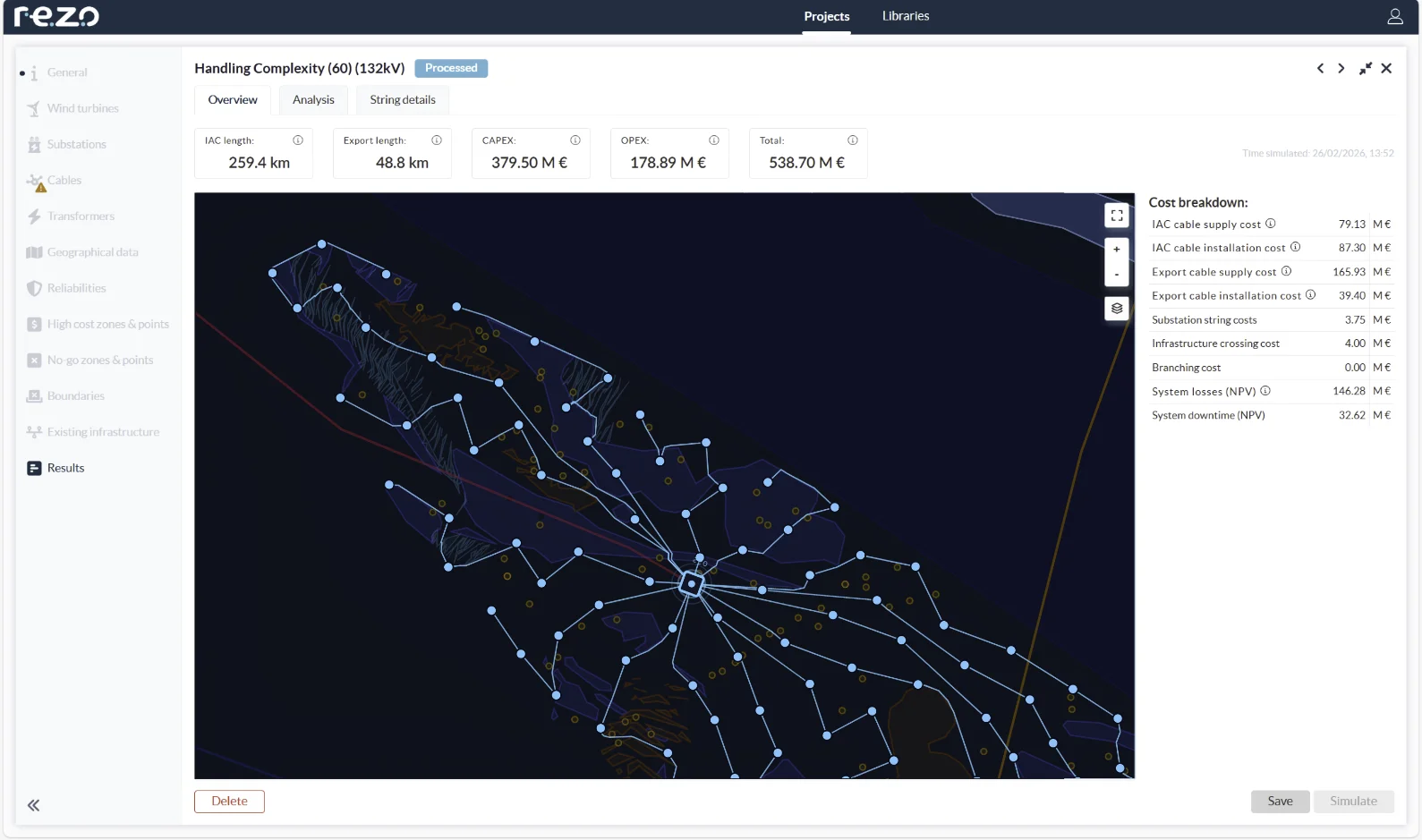
Rezo simultaneously optimises cable sizing, string configuration and routing against the full project lifetime cost, exploring combinations no manual process can feasibly evaluate. And it is no more complex to run than a CAPEX-only simulation. Simply select your optimisation objective before running, and Rezo handles the rest. Every design decision, justified by the numbers.
What Rezo Optimises
In a competitive market, LCoE wins projects
Projects are won on the lifetime cost of energy, not the construction budget. Rezo drives down LCoE by accounting for every cost component that determines whether a grid design is truly cost-effective, not just on paper but over the decades it operates.
Capital Expenditure
Informed decisions on cable supply, installation and substation connection costs across the full design, construction and commissioning phase.
Operational Losses
The cost of energy lost in cables over the full project lifetime, discounted to present value and factored into every sizing decision.
Expected Energy Not Served
Find the right balance between a reliable, high-availability design and its impact on CAPEX, OPEX and insurance fees. Rezo quantifies the reliability cost so you never over-engineer by default.
Site and Technology Specific
Every project is different. Rezo accounts for site-specific production profiles, cable corridors, exclusion zones and existing infrastructure to deliver accurate cable routes tailored to your concession.
Go Further
The full picture, not just the cables
Lifecycle cost optimisation of the inter-array cables is just the starting point. Rezo looks at the entire grid connection system and accounts for the uncertainties that come with any long-term project.
System-Wide Optimisation
Inter-array design, substation location, and export routing are optimised as a single system, unlocking maximum value through rigorous system-level trade-offs.
Design Under Uncertainty
Lifecycle optimisation relies on assumptions about energy prices and discount rates. shows how robust your decisions are before you commit.
By the Numbers
Lifecycle optimisation in practice
On a GW-scale reference project, switching from a CAPEX-only to a lifecycle-optimised design delivered €42.8M in lifetime cost savings.
Same wind farm, with the same cables, same constraints.
Same wind farm, with the same cables, same constraints.
Find out what your grid connection design is really costing you
Run your project through Rezo and get a defensible, lifecycle-optimised grid design that accounts for every cost, upfront and over the lifetime of your asset.
