HVAC or HVDC? Why substation position changes the answer
Last week Stephen Hardy represented Enersynt at the 25th Wind & Solar Integration Workshop in Porto, presenting work on how export technology and substation siting should be decided jointly, not in sequence. Using Rezo, our cloud-based optimisation platform, on a representative 2.1 GW test case, we showed that HVAC and HVDC have different cost-optimal positions and the lower cost technology can flip depending on where the substation is sited.
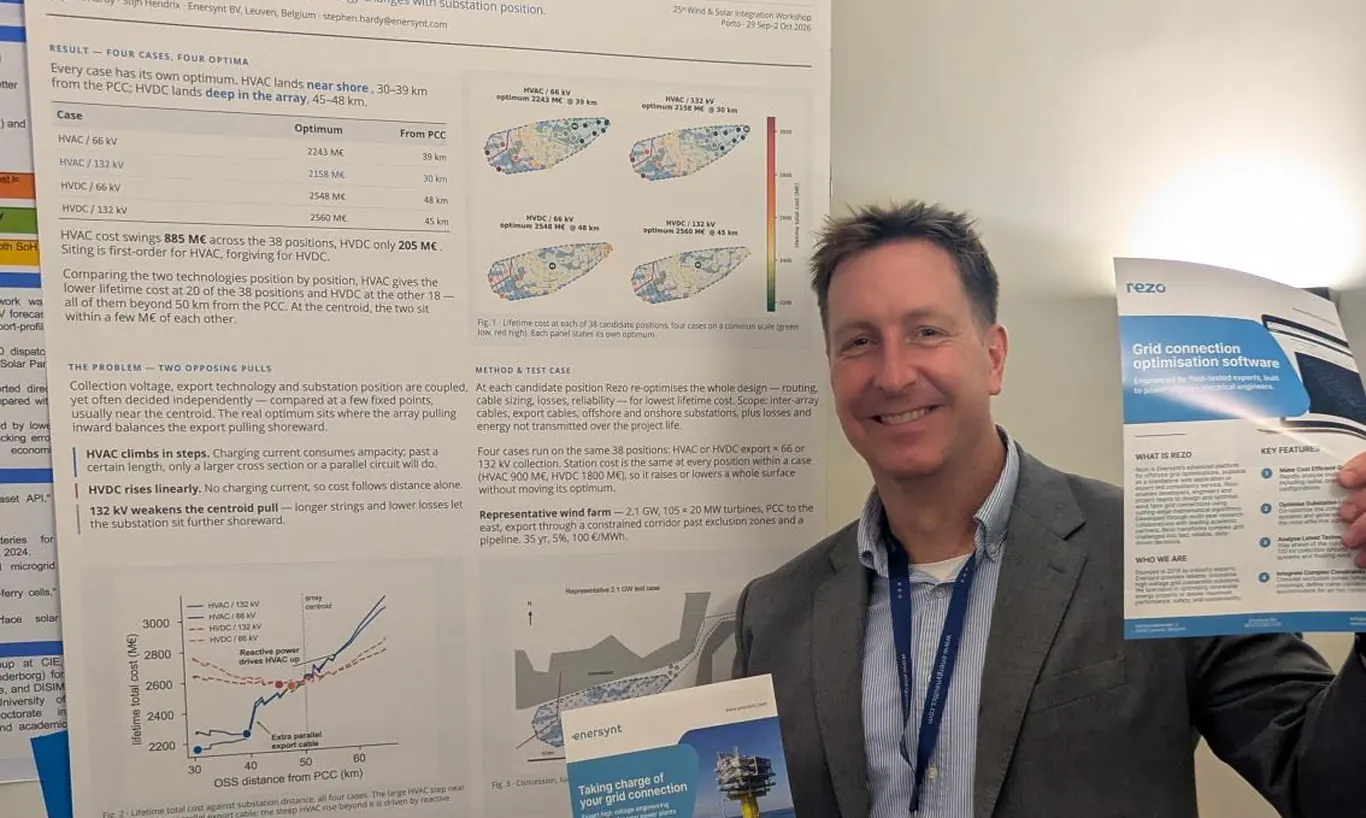

September 29th to October 2nd, Stephen Hardy represented Enersynt at the 25th Wind & Solar Integration Workshop in Porto, presenting a poster titled "Cost surfaces for joint export-technology and substation-position decisions in offshore wind". The workshop draws diverse participants from both academia and industry, and the poster sessions were the right setting for some excellent conversations. We came away with new contacts across developers, OEMs, TSOs and universities.
Thank you to the organisers and to everyone who stopped by to learn about our optimisation cloud computing platform: Rezo.
Cost surfaces for joint export-technology and substation-position decisions in offshore wind
The choice between high-voltage AC (HVAC) and HVDC export in offshore wind is usually made separately from offshore substation (OSS) siting: the two decisions are taken in sequence rather than jointly, with project economics compared at just a handful of fixed offshor substation (OSS) locations, typically near the array centroid. Our experience is that this leaves tens of millions on the table. HVAC and HVDC have different cost-minimising OSS positions, so a fixed-location comparison can return a locally optimal but globally wrong technology answer.
We demonstrate this on a representative 2.1 GW offshore test case built from public data. Joint OSS siting and inter-array cable routing optimised in a way that captures spatial installation constraints, electrical losses, expected energy not transmitted, and lifetime project economics. Wind turbine positions and the point of common coupling are fixed, while OSS position is the decision variable.
Four design cases combining HVAC/HVDC export and 66/132 kV inter-array systems are evaluated. For each candidate OSS location, the model optimises inter-array and export cable routing and computes the associated lifetime cost, producing a cost surface as a function of OSS position.
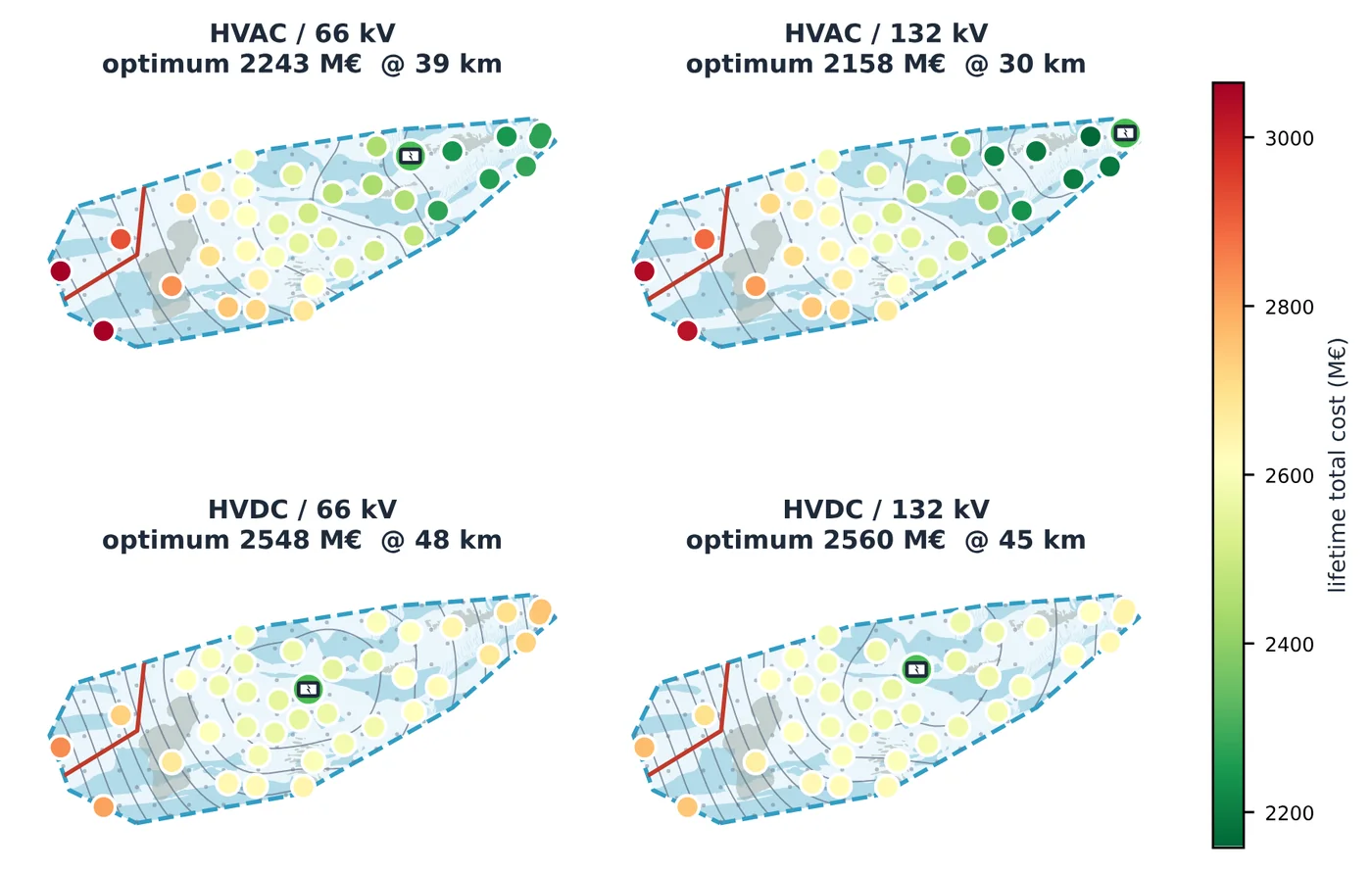
The four cost-minimising OSS positions do not coincide. HVAC favours 30 to 39 km from the point of common coupling; HVDC favours 45 to 48 km, deeper into the concession. The HVAC and HVDC optima are 6 to 18 km apart depending on the voltage pairing, while inter-array voltage introduces smaller secondary shifts. Export technology dominates OSS position and inter-array voltage is secondary, but both move the optimum. The asymmetry is physically interpretable: HVAC export cost grows steeply with distance due to capacitive charging current, pulling the OSS shorewards; HVDC is length-insensitive, so the OSS sits closer to the wind farm centroid to minimise inter-array length.
The position-induced cost spread is highly asymmetric: HVAC's surface varies several times more than HVDC's. The two total-cost ranges overlap, so the technology answer depends on where the OSS is sited. HVAC wins at HVAC's optimum; HVDC wins if the OSS is placed toward HVDC's. This reversal is not a hypothetical edge effect. It occurs inside a single concession, across the positions a real project would actually consider, and the preferred collection voltage flips with OSS position in the same way.
This test case is highly representative of the projects we work on today, and our experience is consistent: the business-as-usual approach leaves large savings on the table, from both technology choice and OSS position. The optima do not coincide, and within one concession the cheaper technology and the preferred collection voltage both flip with position. With tens of millions of euros at stake, the whole concession should be evaluated, not a handful of points. Optimisation software like Rezo makes this routine, and with 132 kV collection soon to arrive, the time to make it standard practice is now.
Read more
The full paper will appear in the IET Digital Conference Proceedings. For early access please contact us directly. If you have your own concession where you think this analysis would be helpful, or want to discuss other features of Rezo, please get in touch.
Further Insights
Order early, order right: taking long-lead equipment off the critical path
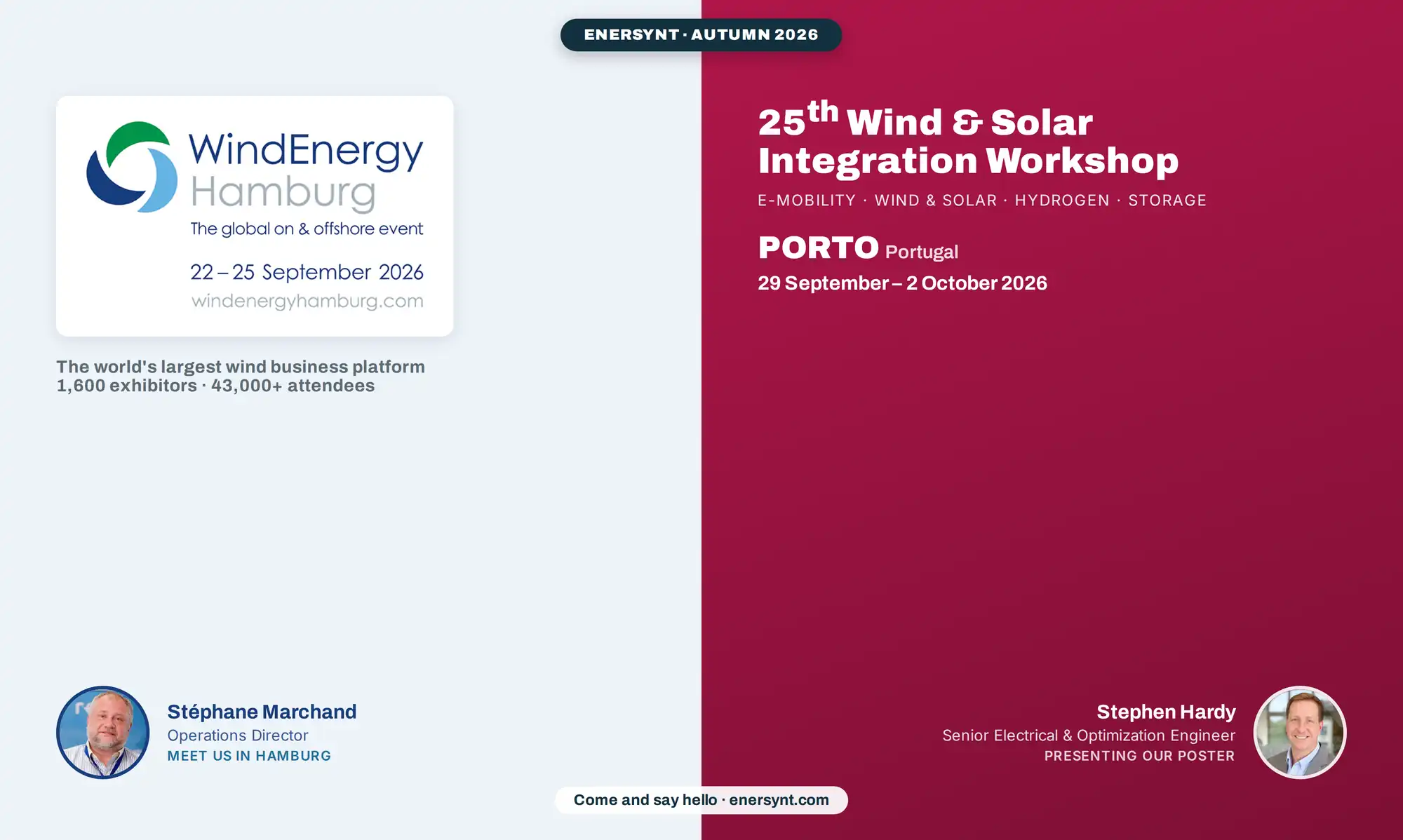
Meet Enersynt in Hamburg and Porto