Rezo Deep Dive 1: the base case
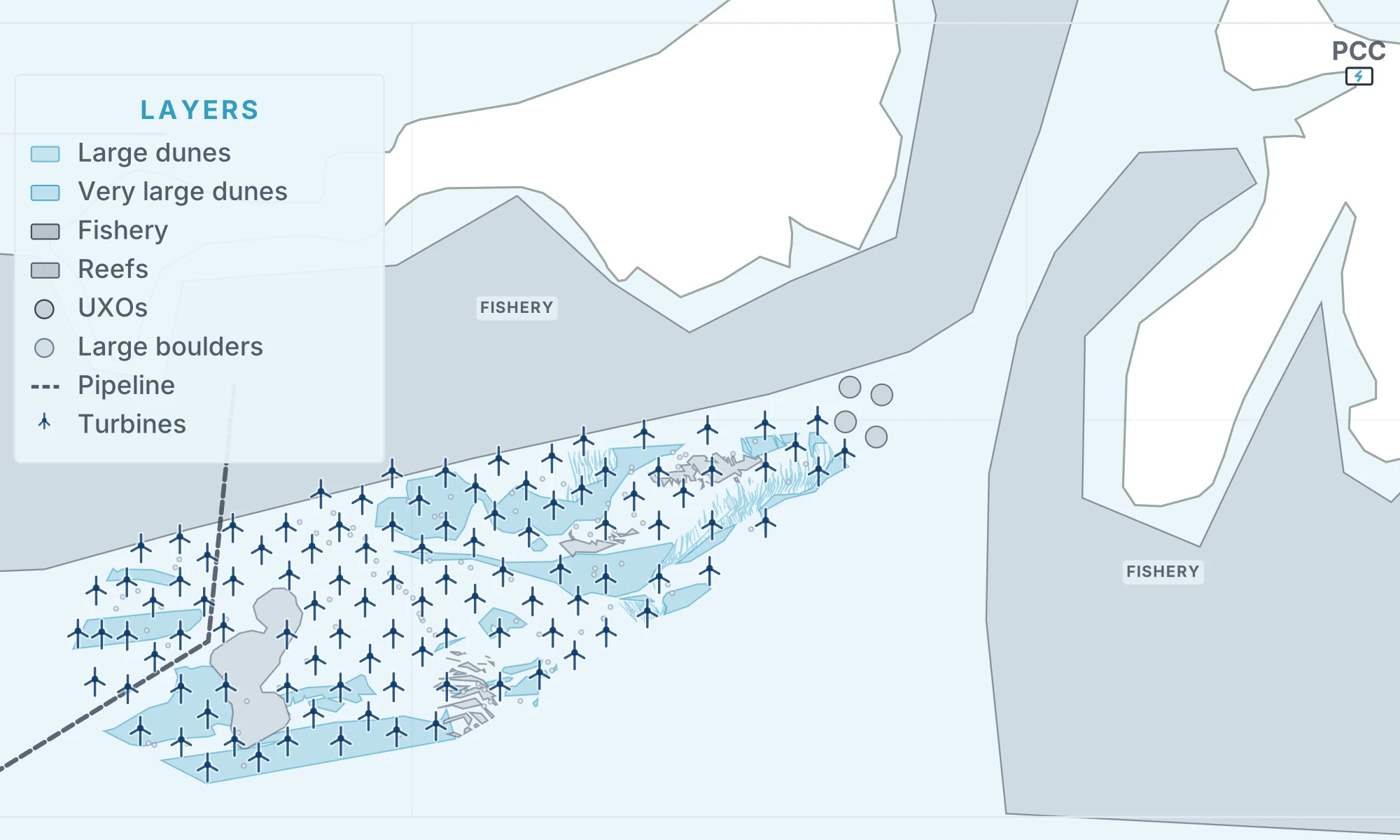
This representative 2.1 GW offshore wind farm, which we call Pacific Wind, is about 49 km from shore, connected to an onshore point of common coupling (PCC) through a single export corridor. Its base case is a mature design at FEED level. The seabed holds exclusion zones (fisheries, reefs, boulder fields, unexploded ordnance), high-cost installation zones (sand waves) and an existing subsea pipeline.

Introducing Pacific Wind
Before the cost of a grid connection can be reduced, you need a strong baseline. This post introduces ours: Pacific Wind, a representative offshore wind farm of 105 turbines rated at 20 MW each, and the base case grid connection design that every alternative in the series is compared with. Pacific Wind is not a real project; we built it so we can present and discuss aspects of offshore topology optimisation openly. It is the reference case for the studies run with Rezo, our cloud-based optimisation platform, introduced in Rezo Deep Dive: introduction.
Key takeaways
- Pacific Wind is a representative 2.1 GW offshore wind farm, with 105 × 20 MW turbines about 49 km from shore, used as the reference case for the series.
- Designing the grid connection before the turbine layout is final is costly when every layout change means manual rework. Rezo makes re-optimisation fast enough for teams to start early.
- The base case is a mature design at front-end engineering design (FEED) level: a 525 kV high voltage direct current (HVDC) bi-pole export, a 66 kV inter-array cable network, the offshore substation at the centre of the concession.
- The inter-array cable design is a mathematical optimum for the constraints it was given, with certain assumptions fixed on purpose.
- Its cable lifecycle cost is €805M, within a full system cost of €2,605M. Every later deep dive is compared with that base case.
How do you design a grid connection before the turbine layout is final?
We have all seen it in projects. The wind farm layout keeps changing in the search for a higher yield, as different turbine platforms are considered and emerging soil data changes foundation costs. Within that moving picture, the transmission system design team is responsible for a robust grid connection up to the point of common coupling: the export technology, the number of substations, the type and length of the cables.
Much of the information that design depends on is still incomplete at this stage. Detailed survey data along the expected cable routes is often not available yet. Nor are detailed supplier costs for the substation and cable assets. Even the transmission technology, the number of export cables, required level of redundancy, and number of offshore substations is often not set in stone.
Reworking the design by hand every time the turbine layout changes is costly, so teams often wait until the last possible moment to design the electrical infrastructure. Rezo takes the time-intensive part out of recalculating the substation position, the inter-array cable layout and the connection to shore. Teams can start earlier, run sensitivity analyses and arrive at more robust designs in challenging conditions. That makes this an interesting phase of any project: there are still levers to pull that may reveal a more cost-efficient design.
Pacific Wind’s base case was developed against that backdrop. The turbine layout stays fixed throughout this series, while later posts bring in additional information along the way.
Essentials
- Capacity: 2.1 GW, 105 × 20 MW turbines
- Location: roughly 49 km offshore, single export corridor to an onshore point of common coupling (PCC)
- Design life: 35 years
- Discount rate: 5%
- Energy price: €100/MWh
What does the seabed look like?
The seabed is not empty. 37 exclusion zones (fisheries, reefs, boulder fields, unexploded ordnance) prohibit cable installation entirely. 133 high-cost installation zones (sand waves requiring pre-excavation) multiply installation cost by up to 3×. A subsea pipeline crosses the concession, with a discrete crossing penalty per intersection.

What makes this a base case?
The base case is a 525 kV HVDC bi-pole export with a 66 kV inter-array cable network (see Figure 2). It is a mature design, of a kind common at this stage of a project: well thought out, developed to FEED level, with extensive cost optimisation based on the information available. The project team simply does not yet have all the information, or the time or experience, to evaluate further optimisation options.
Why an HVDC export?
At 2.1 GW, an AC export is often dismissed. It needs a high number of export cables, multiple offshore substations and, depending on the distance to shore, mid-point compensation. An HVDC solution needs a single set of export cables, so the offshore substation (OSS) naturally gravitates towards the centre of the concession. That is where the base case places it.
How was the inter-array design optimised?
The inter-array cable design was developed with Rezo. It is optimised on capital expenditure (CAPEX) alone, which typically reduces the overall cable length and cross-sections as far as possible. For this design, Rezo selected 3 cable types from the standard cable library to reach the lowest possible investment cost.

Within the constraints it was given, the result is a mathematical optimum. For those constraints, it is therefore likely to be more efficient than a manual design, even one by an experienced engineer. The constraints are deliberate:
- Soil conditions: complex soil conditions have not been modelled in full detail, except for the zones where cables may not be installed. Further analysis of the site-specific soil conditions and their effect on installation cost could yield improvements.
- Operating costs: they are not part of the optimisation, as the design team favoured reducing the investment cost to a minimum.
- Substation position: the substation is fixed early in the design, possibly driven by foundation requirements more than by electrical cost impact.
What does the base case cost?
The cable lifecycle cost is €805M, expressed as a net present value over a 35-year design life at a 5% discount rate. Of that, €418M is CAPEX and €387M is operating expenditure (OPEX). Lifetime operating costs almost match the investment, yet the cable sizes were chosen on investment cost alone.
Most of the inter-array cable system investment goes into buying and installing the cable: supply accounts for 57%, installation for 40%; the substation bays and pipeline crossings make up the rest. Running costs for the 66 kV system are almost entirely losses, split between the turbine transformers (52%) and the cables (47%), while energy not supplied because of outages is about 1%. The inter-array network totals 334 km: 271 km through standard seabed, 62 km through high-cost zones at 3× installation cost and about 1 km at 2×, with five crossings of the subsea pipeline.
The cable lifecycle cost sits within a full system cost of €2,605M. The remaining €1,800M is the HVDC export system. Every alternative in this series is compared with that €2,605M.
The following posts lift the base case constraints one at a time, to investigate how revisiting the assumptions a project team has taken could unlock substantial project savings.
Follow Enersynt on LinkedIn for each deep dive as it lands. Have a concession where this could help? Get in touch.
Further Insights
Rezo Deep Dive: introduction
Order early, order right: taking long-lead equipment off the critical path
HVAC or HVDC? Why substation position changes the answer
Meet Enersynt in Hamburg and Porto