Princess Elisabeth Zone: five electrical challenges to solve before you bid
The Princess Elisabeth Zone connects straight into Elia’s energy island. That creates electrical challenges that need solving, and pricing, before the bid.
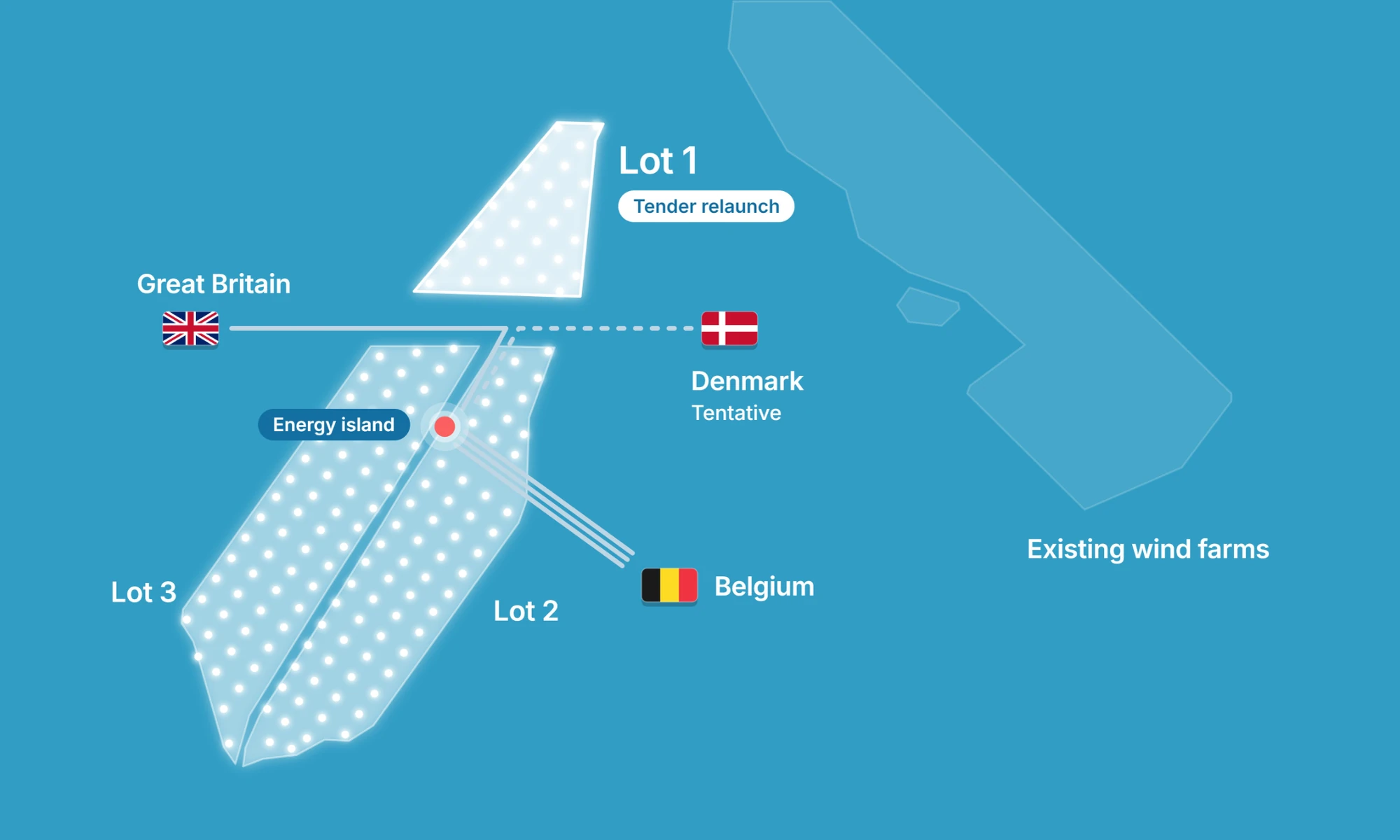

On 10 November 2026 the European Commission approved Belgium’s €2.04 billion support scheme for Lot 1 in the Princess Elisabeth Zone. The government is now expected to relaunch the tender shortly, with the award expected in the fourth quarter of 2027. The relaunch follows the cancellation of the first tender in July 2025. The site takes up to 735 MW and support is a single 20-year two-way contract for difference (CfD), where the lowest strike price wins. Under the new tender rules, bidders will have five years to build instead of the original four.
What has not changed is the connection. Lot 1 will be the first wind farm to connect to Elia’s Princess Elisabeth Island, the world’s first artificial energy island. Its 66 kV inter-array cables run straight into one of the island’s substations. The island’s first phase has to be in service by 1 October 2031.
That moves the challenges to the grid integration and the cable system. Several need solving, and pricing, by developers before the bid, not after award.
Grid integration
Many converters on one node
Lots 1 and 2 share one AC node on the island: about 2.1 GW of offshore wind, connected to the onshore grid by six 220 kV export cables. Almost everything on that node is inverter-based. The island’s other node was planned for a 2 GW, 525 kV HVDC bipole; Elia is now investigating a smaller 320 kV symmetrical monopole instead to reduce the cost of the energy island’s electrical infrastructure.
Elia has flagged the risk itself in its 2024 consultation on the Princess Elisabeth Zone: adverse interactions between the control systems of nearby inverter-based plants. These play out in fast timeframes that RMS (root mean square) stability tools have often failed to predict. Elia’s answer is to make wide-area electromagnetic transient (EMT) modelling, representing most of the surrounding system explicitly, part of grid compliance. That adds a risk for developers: their grid compliance now depends on interactions with third-party plants, in a black-box model that Elia manages.
Under Elia’s conformity process, the wind farm must also supply vendor-specific RMS and EMT models from the connection study onwards. These must be validated against commissioning measurements, and only then does the wind farm receive its final operational notification (FON), the last step of grid compliance.
And the FON may no longer be the end of the story. Elia expects that connected generators may be asked, under reasonable conditions, for a best-effort assessment of their dynamic performance as new connections arrive, so compliance looks beyond the year of connection. For Lot 1, those new connections include Lot 2 and whatever the island’s next phase becomes. For the first time in Belgium, a wind farm’s grid compliance will depend on projects that have not yet been built.
Island space is at a premium
Elia has made clear that wind farms cannot install additional equipment on the island. That removes the standard fallback when studies show a shortfall: no extra reactive compensation, no harmonic filters. With Elia setting the 66 kV voltage through the on-load tap changers of its island transformers, reactive power and harmonic performance must come from the turbines themselves.
What this means for the bid
With no fallback on the island, the turbine has to be right from the start. Reactive power capability, harmonic performance and the quality of its EMT model become selection criteria, studied before the turbine supplier is locked in.
Timing matters as much as performance. Elia must accept the models and grid studies before energisation, so a late model means a late wind farm. Bidders should agree the study scope and schedule with Elia early.
The turbine supply contract or a dedicated power system studies contract should carry the interaction risk too: model updates, and support for further studies after FON as later phases connect to the island.
Cable system and layout
Seabed and corridor
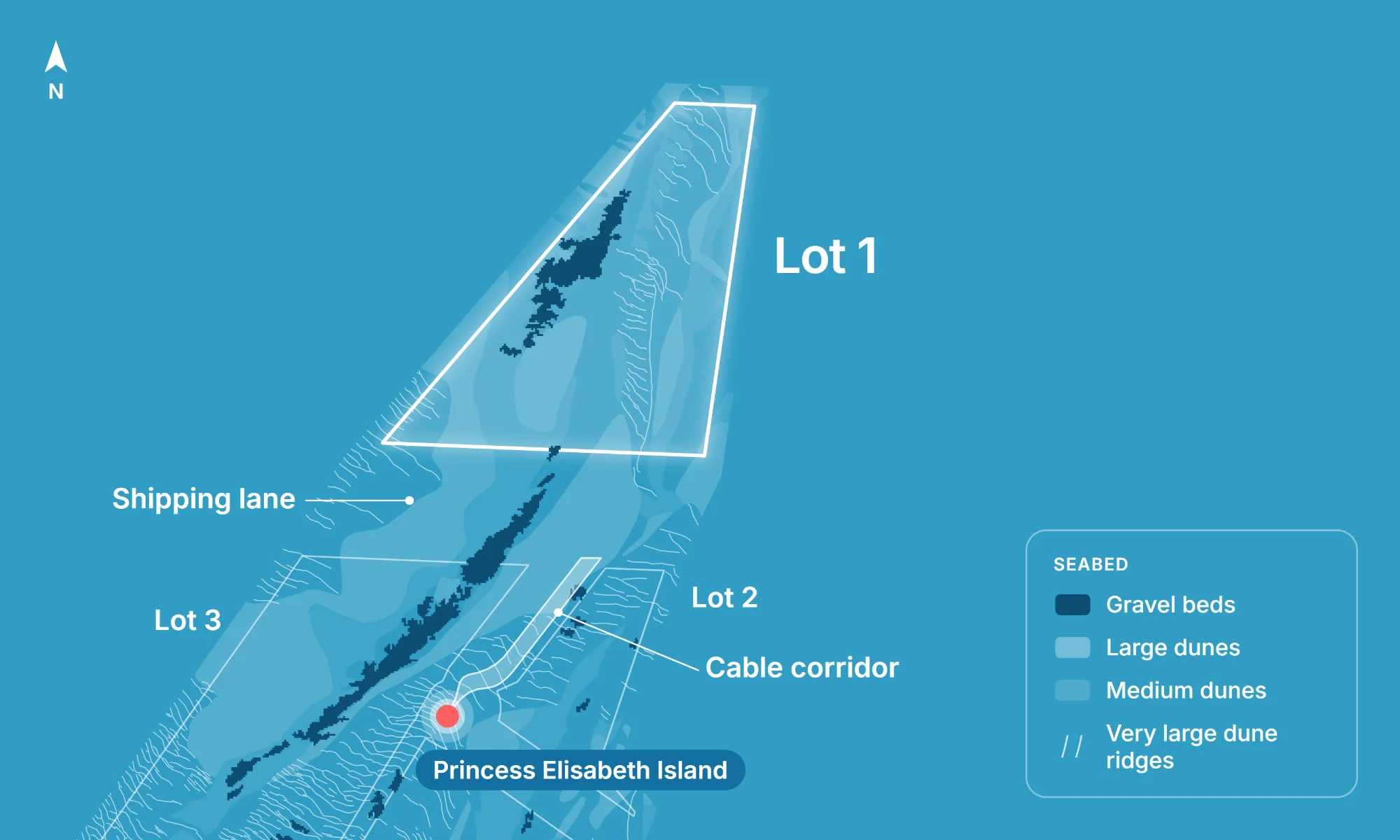
Gravel beds and mobile sand dunes run through the concession and along the cable corridor from Lot 1 to the energy island. Together they challenge thermal performance, burial assessment, cable selection and routing. A cable rated for one seabed condition may sit in a completely different one a few years later.
The corridor from Lot 1 to the island is long and relatively narrow. It runs through very high sand dunes and crosses a shipping lane. Combined with the permit requirement to install cables 1 metre below the base of the moving sand dunes, these make for difficult conditions: deep burial for protection, a shifting upper layer, limited space between circuits, and few options if a cable has to be repaired.
Layout and cost per bay
Grid connection costs apply per connected bay. That turns the number of array strings into a commercial decision as much as a technical one. Fewer, more heavily loaded strings save bays, and therefore grid tariffs, but they need larger cables and carry higher losses. More strings mean more bays, and more exposure to a future grid tariff that is not yet known.
Seabed conditions, cable sizing and the number of bays are therefore one trade-off, and they belong in the same optimisation. Rezo, Enersynt’s cloud-based optimisation platform, optimises cable routing and sizing together for a given turbine layout, taking seabed conditions and connection costs into account, so these trade-offs can be compared across many configurations rather than a handful.
Pull-in and routing on the island
The last stretch to the island substation brings its own set of challenges.
- Stabilisation over the island scour protection. Cables approach a vertical caisson wall across extensive scour protection that is already in place. They are exposed to significant currents and will require stabilising along that stretch.
- Non-standard thermal conditions. The J-tubes, each with two entry holes, run through a concrete caisson cell filled with standing water. That needs a dedicated thermal assessment, likely with finite element calculations, not a standard approach based on IEC calculation methods.
- Routing to the substation. From the caisson, the cable either makes a very long overpull of submarine cable, or is jointed to land cables between the first and second wave wall. The choice trades installation risk against the reliability and rating of the extra joints. Regardless of the choice, the hang-off and possible joint will have to be designed for potential salt water submersion as the area between both wave walls is designed to be flooded in certain storm conditions.
None of these is new technology, but each is specific to this island and each affects cable cost, rating or schedule. They need assessing before the cable system design is fixed.
Pricing the interfaces
Lot 1’s biggest challenges sit in the interfaces between turbine, cable and island: grid compliance on an offshore energy hub that is still changing, a demanding seabed and corridor, and a pull-in onto an island with no room for late fixes. Each one is hard to change once the turbine and cable contracts are signed. They should be studied early and priced into the bid, not discovered after award.
Preparing a bid for the Princess Elisabeth Zone? Get in touch to discuss how Enersynt can help you manage these challenges.
Further Insights
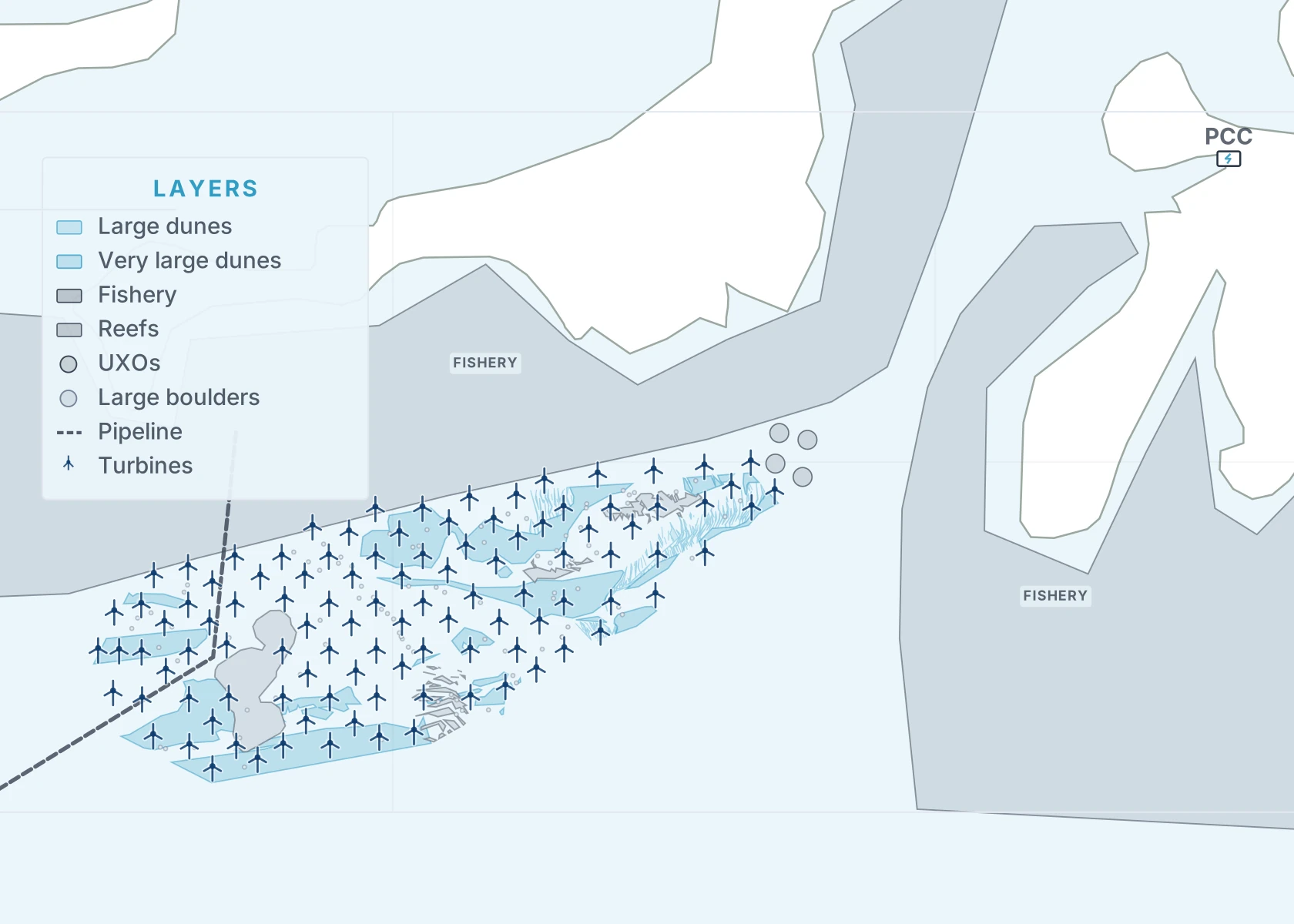
Rezo Deep Dive 1: the base case
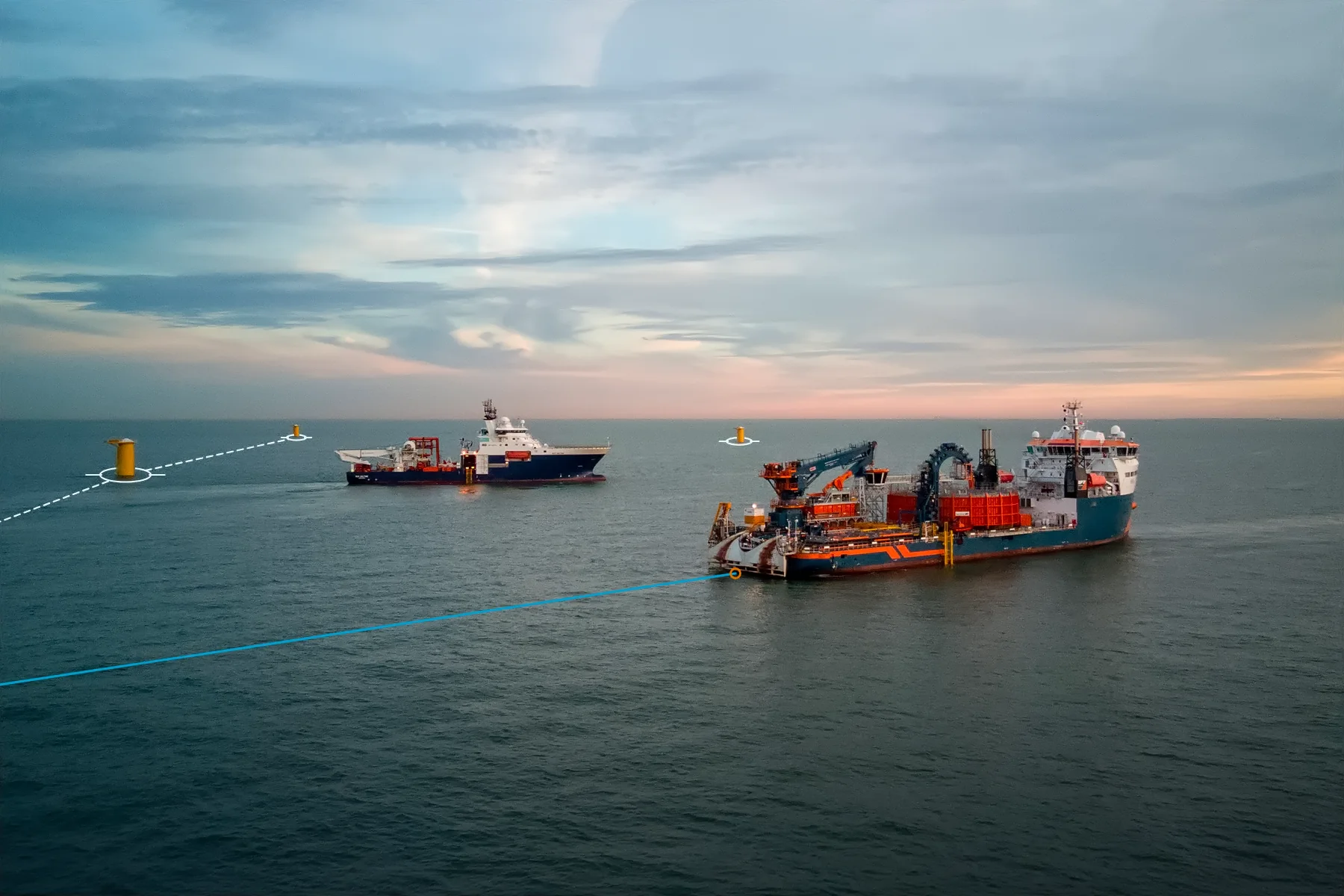
Rezo Deep Dive: introduction
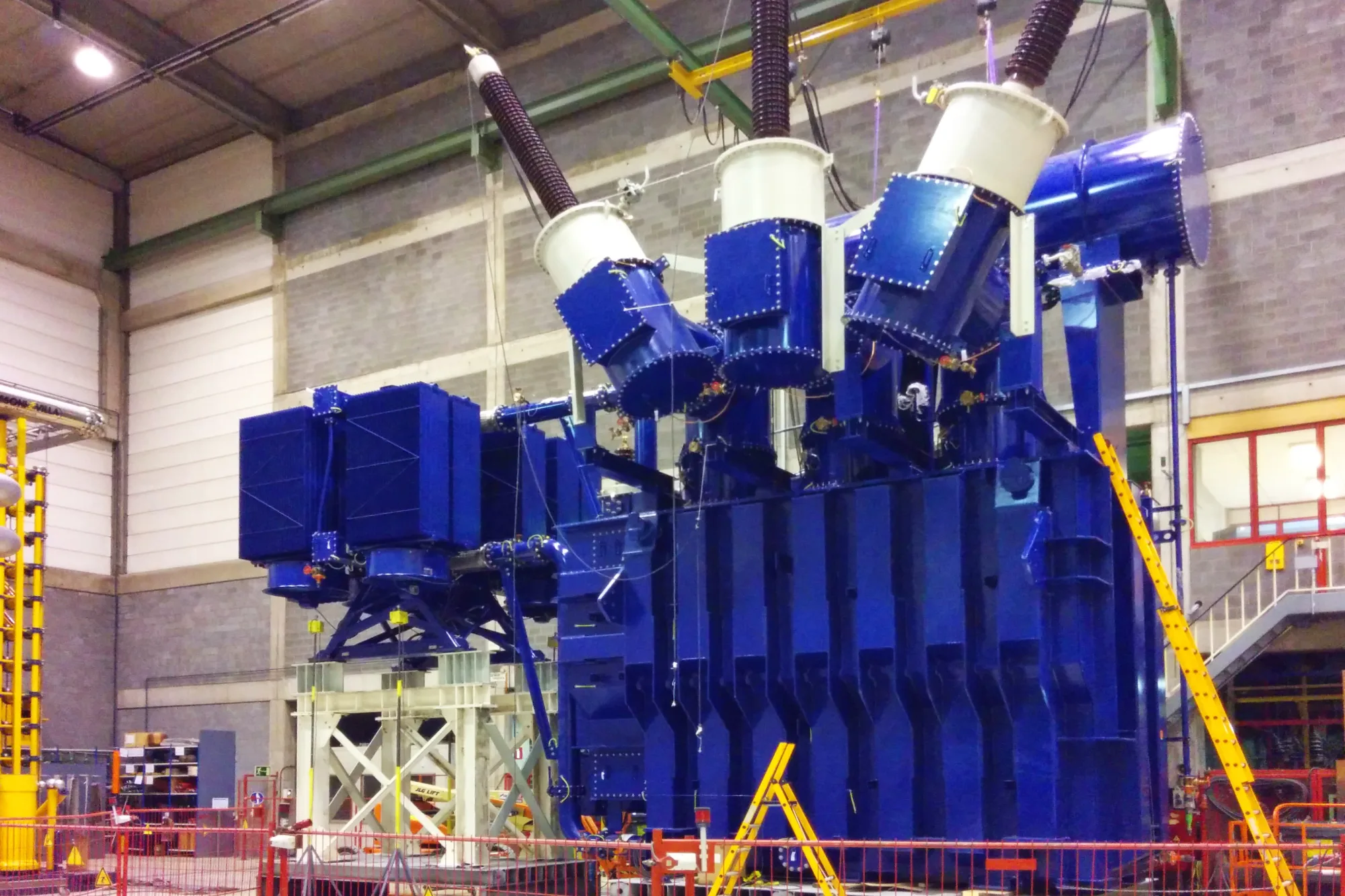
Order early, order right: taking long-lead equipment off the critical path
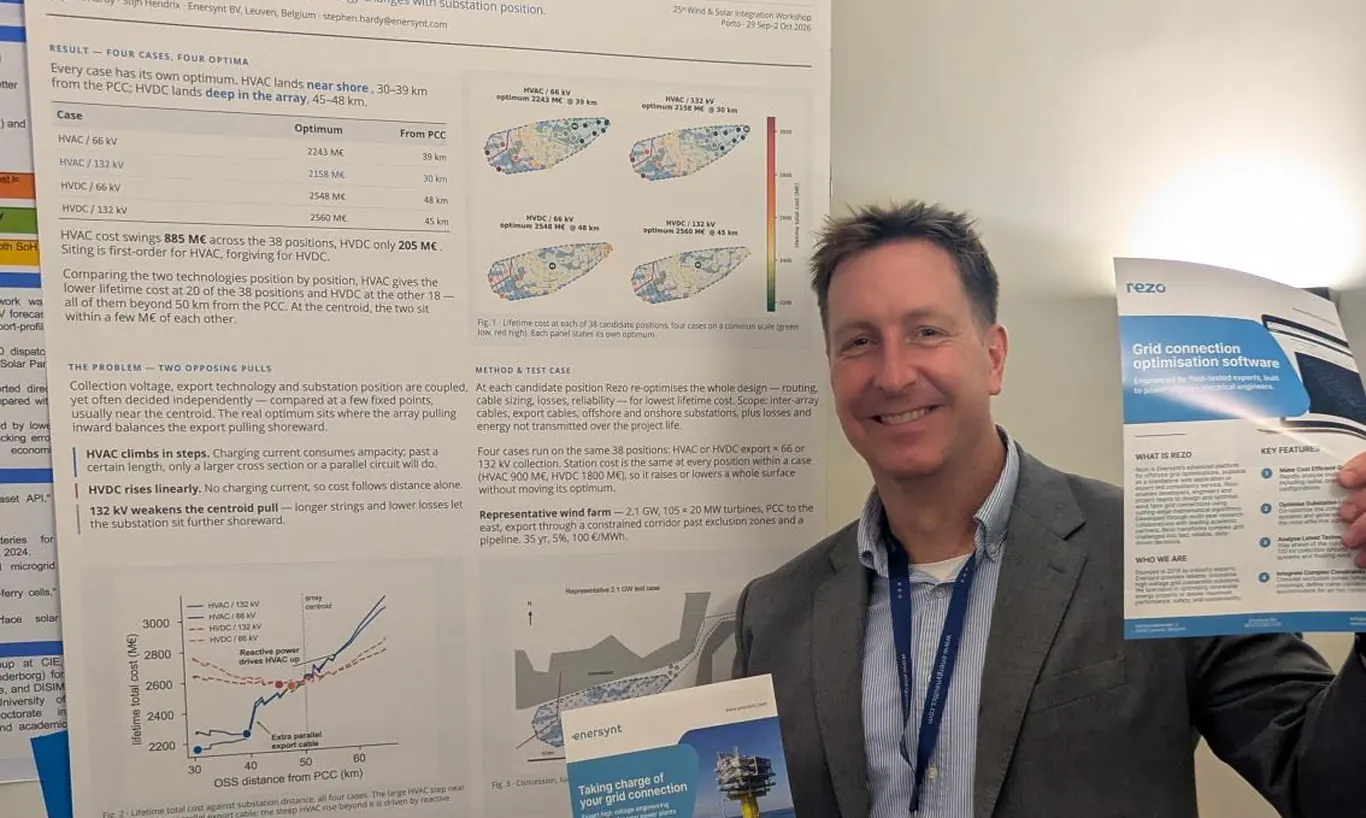
HVAC or HVDC? Why substation position changes the answer
Meet Enersynt in Hamburg and Porto